
A portable anemometer primarily measures the speed of an airflow, but can also be used to calculate the volumetric flow rate in a ventilation duct, or at a supply or exhaust vent. Today, these instruments often incorporate a temperature sensor to measure the temperature of the airflow and its velocity at the same time, which is why they are called thermo-anemometers.
Measuring the volumetric flow rate of supply and exhaust air not only ensures that an aeraulic system is working properly, but is also necessary for assessing the indoor air change rate (IARR) and mixing rate, which are key parameters in indoor air quality (IAQ) and pressure cascades within a building.
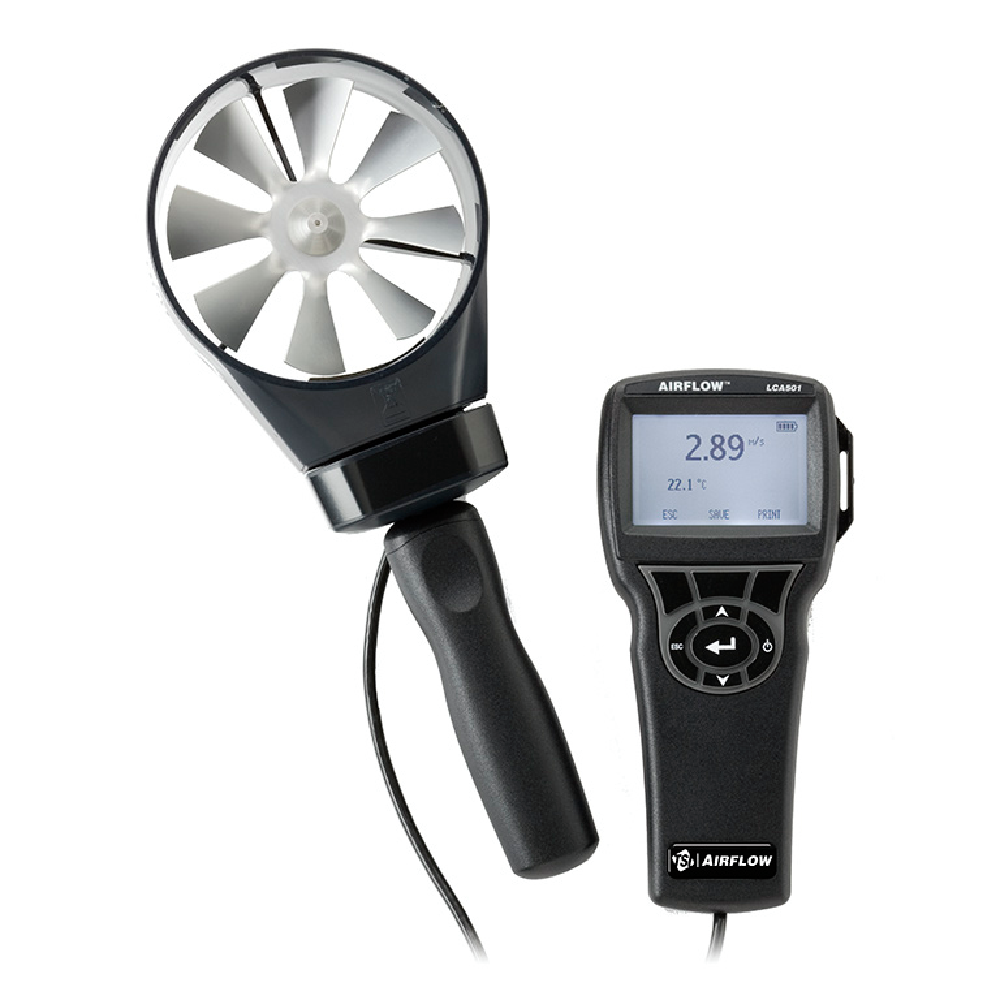
Airflow Instruments Rotating Vanes LCA501
Model Number: LCA501
The Airflowâ„¢ Instruments Rotating Vanes LCA501 is a hand held digital Rotating Vane Anemometer used for air velocity and volumetric flow measurements.
Thermo-anemometer with integrated vane probe LV 50
The Kimo LV 50 is a handheld thermo-anemometer for air velocity, temperature and detection of air flow direction.
Thermo-anemometer with hotwire probe VT 50
The Kimo VT 50 Thermo-Anemometer measures air velocity (i.e. the speed of the air) at small openings and hoods – to help ascertain the performance characteristics of a system.
Thermo-anemometer with integrated vane probe LV 110 / 111 / 117
The Kimo LV 110 / 111 / 117 displays velocity and temperature measurements.
Hotwire thermo-anemometer VT 110 / VT 115
Kimo’s VT 110 / 115 is perfect for measuring airflow, air velocity and temperature with its hot wire probe.
Hotwire Thermo-anemometer With integrated hotwire probe Si-VH3
The palm-sized Sauermann Si-VH3 hotwire thermo-anemometer easily measures airflow, air velocity & temperature with its hotwire probe with telescopic rod.
Thermo-anemometer with integrated vane probe LV 130
The Kimo LV 130 precisely measures air velocity and ambient temperature with a rotating vane probe.
Vane Thermo-anemometer with integrated vane probe Si-VV3
The palm-sized Sauermann Si-VV3 vane thermo-anemometer easily measures airflow, air velocity & temperature with its vane probe.
What are the different kinds of anemometers?
There are many different anemometer technologies for measuring air flow velocity. Some are better suited to measuring wind (outdoor airflow), while others are used in particular to measure indoor airflow: supply air, fresh air, recirculation air, or even air draughts, however slight, air leakage within a building, but also airflow within an air duct forming part of an air-conditioning or ventilation system. Here are the different types of anemometers and the areas in which they are best used:- Vane anemometers (indoor and outdoor air):Â These instruments use a vane to measure the speed of an air stream. These models are fairly versatile, the most sensitive being preferred for indoor measurements with a 100 mm diameter vane. Some small-diameter portable vane anemometers are often used for outdoor wind speed measurements in some recreative activities, but professionals also use small diameters for duct measurements.
- Hot wire anemometer (indoor):Â These anemometers measure air velocity using a simple thermal principle: the sensor is a wire heated by the Joule effect (low electrical current), and passing air flow cools it by convection. The cooling modifies the electrical resistance of the wire, making it possible to accurately assess the velocity and flow rate of an air stream, even a very weak one (blower door test measurement used to detect air-tightness defects in a building). The measurement accuracy of this technology is very high, but in return requires high quality manufacturing and calibration by the manufacturer.
- Pitot tube measurement (indoor):Â These anemometers are in fact manometers whose pressure sensor is associated with Pitot tube technology: they measure the variation in pressure in a Pitot tube as an air flow passes through a duct or ventilation opening. The difference between the static pressure and the total pressure generated by the airflow is then used to determine the speed of an airflow fairly accurately, but with a sensitivity lower than that of the hot wire (above 2 m/s) and only in ducts.
- Cup anemometer (outdoor, wind measurement):Â These anemometers measure wind speed using cups attached to a vertical shaft. The wind rotates the cups, and the velocity of the air is calculated as a function of their rotation speed. These devices are still sensitive for measuring light breezes, but can also measure powerful wind gusts.
- Ultrasonic anemometer (indoor and outdoor):Â Ultrasonic anemometers are versatile and extremely accurate. They are also very robust, as they have no mechanical parts. Used both indoors and outdoors, they are often found in weather stations, but also in certain specific industrial environments and in scientific research to study atmospheric dynamics. These devices emit sound pulses between 20 and 200 kHz, and are fitted with receivers that measure the propagation time of the sound waves, directly induced by the speed of the air through which they travel.
- Doppler or laser anemometers (indoor and outdoor):Â These anemometers are very accurate but also very expensive. They are also very similar to radar anemometers (electromagnetic waves). Their advantage lies in their ability to take measurements in air as well as in non-gaseous fluids, and above all to do so non-intrusively, i.e. without disturbing the flow of the measured stream. They emit light or electromagnetic waves, and detect the frequency shift between a transmitted beam and its return. These devices are not generally used in HVAC applications.


Humidification
Dehumidification
HVAC Measuring instruments
HVAC Sensors & Field Devices
Air Particles Counting
Microbial Air Sampler